







Reflections from Yogyakarta: Why Moldova Needs Urgent AI Governance
.jpeg)
Returning from the ASEMHRS23 capacity-building training on "Future-Proofing AI: Building Human-in-the-Loop Governance Skills for Rights-Respecting AI" in Yogyakarta, Indonesia, I am profoundly struck by the vibrant Asia-Europe dialogue on crafting rights-respecting AI systems.
Disclaimer: I participated as a Romanian national due to Moldova's noticeable absence from the Asia-Europe Foundation (ASEF). Civil society representatives, NGOs, diplomats, and researchers converged to tackle AI's sweeping implications for human rights: privacy erosion, equality breaches, non-discrimination failures, and barriers to justice access. The event's core message rang clear: networked governance is essential, as no single actor can rein in AI's unchecked expansion alone.
Bridging Socio-Technical Divides
The training exposed a glaring socio-technical gap that we must urgently address. Sessions, often dominated by legal, diplomatic, and policy perspectives, repeatedly called for deeper integration of technical expertise. Effective AI governance requires fusing these domains to rigorously evaluate risks such as algorithmic bias, data opacity, and opaque decision-making chains. Without engineers and data scientists at the table, policymakers risk crafting toothless rules that fail against sophisticated systems.
AI's blistering evolution consistently outpaces regulatory efforts worldwide. The EU AI Act, once hailed as a trailblazer, encountered significant delays through the European Commission's 2025 "Omnibus" proposal, addressing thorny implementation hurdles and postponing major prohibitions and obligations to 2026–2027.
Asia's Actionable Models
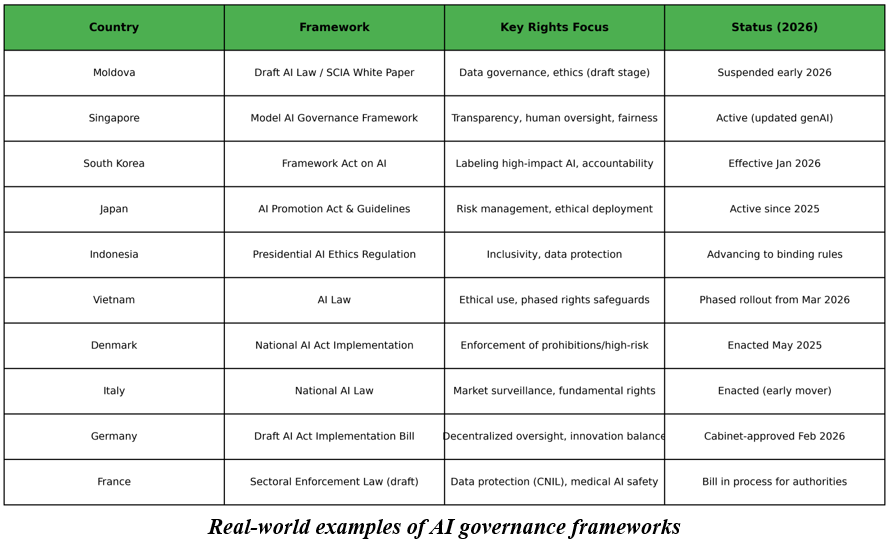
Asia's contributions at ASEMHRS23 impressed with pragmatic, deployable frameworks that prioritize immediate rights-respecting AI rollout over exhaustive supranational harmonization. Singapore's Model AI Governance Framework, updated for generative AI, mandates transparency, accountability, and robust human oversight in high-risk deployments, equipping organizations with self-assessment tools without stifling innovation.
South Korea's Framework Act on AI took effect in January 2026, introducing binding notifications for high-impact systems and labeling for generative outputs to curb misinformation. Japan's AI Promotion Act of 2025 established a national strategy headquarters with guidelines balancing risk management, voluntary audits, and ethical sandboxes. Indonesia showcased presidential regulations embedding inclusivity, data minimization, and protection, tailored to diverse contexts.
These models demonstrate agility: iterative evolution, stakeholder feedback, and prompt deployment. Europe could learn; while the EU AI Act categorizes risks (unacceptable, high, limited, minimal), Asia emphasizes scalable ethics-by-design for trust.
Moldova's Critical Lag
Moldova trails perilously behind. Despite signing the Council of Europe Framework Convention on AI in September 2024, a 36-article treaty on human rights, democracy, and rule of law, it lacks a standalone national AI law. A 2024 draft stalled in early 2026 per EU advice, mirroring AI Act revisions, leaving a vacuum where innovation overshadows rights.
The Sub-Council on AI and Data Governance (SCIA), formed July 2024 under the National Digital Transformation Council, coordinates via the October 2024 White Paper, outlining education, infrastructure, uptake, and sandboxes. AGEPI proposals advocate EU-aligned ethics for growth, but efforts remain advisory, tilting toward 2023-2030 digital acceleration with rights secondary.
EU accession breeds complacency amid no firm timeline and Brussels delays. Proactive peers advance: Denmark's AI law entered force August 2025 for enforcement; Germany's bill was cabinet-approved February 2026.
Urgent Recommendations for Moldova
As a UN member and Council of Europe signatory, Moldova must prioritize a framework centering privacy/data protection, equality/non-discrimination, and remedies. First, finalize an EU AI Act-compatible law via SCIA with risk tiers.
Second, integrate technical voices: form interdisciplinary groups of coders, ethicists, and advocates to audit e-governance/justice AI, launching "human-in-the-loop" sandboxes flagging biases.
Third, deepen ties: join partner Europe-Asian hubs for capacity-building/data governance, piloting rights impact assessments and high-risk registries.
The Imperative of Speed
ASEMHRS23's takeaway: AI's velocity demands action. EU AI Act risks obsolescence post-Omnibus; Asia leads - Singapore oversight, South Korea labeling, Japan ethics. Moldova cannot delay amid AGI threats.
Blending Asia's agility with Europe's rigor, Moldova can pioneer rights-first governance. Step up, or be sidelined.

Textele de pe pagina web a Centrului de Investigații Jurnalistice www.anticoruptie.md sunt realizate de jurnaliști, cu respectarea normelor deontologice și sunt protejate de dreptul de autor. Preluarea textelor știrilor și a investigațiilor jurnalistice se realizează în limita maximă de 500 de semne. În mod obligatoriu, în cazul paginilor web (portaluri, agenții, instituţii media sau bloguri) trebuie indicat şi linkul direct la articolul preluat de pe www.anticoruptie.md în primul alineat, iar în cazul posturilor de radio și TV – se citează obligatoriu sursa. Preluarea integrală a textelor se poate realiza doar în condiţiile unui acord prealabil semnat cu Centrul de Investigații Jurnalistice.







Subscribe